
Call it fate, fortune or simply the strange arithmetic of Test cricket, but once again Australia found a way to turn chaos into control. If the opening day of the Adelaide Test felt like a jigsaw thrown into the air, most of the pieces landed face up for the hosts. England hurled the puzzle skyward; Australia calmly put it back together.
It has been the recurring rhythm of this Ashes. England knock Australia over, only for something sturdier to rise from the rubble. Perth brought a collapse answered by an even bigger one. Brisbane saw another slide, only for the lower order to claw Australia back. Adelaide followed the same script.
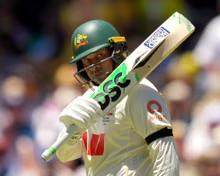
England arrived with a plan forged from hard truths: you cannot win in Australia with medium-fast seamers and a keeper up to the stumps. And yet, they lost twice in six days to precisely that combination. The third Test seemed to offer them fresh gifts. No Pat Cummins. No Josh Hazlewood. No Nathan Lyon earlier in the series. Now, no Steve Smith, ruled out by an inner-ear problem. In his place stood Usman Khawaja, an opener Australia had already tried – and failed – to discard.
England, almost apologetically, tried to remove him too. On five runs, with Australia 50 for two, Harry Brook spilled a straightforward chance at slip. Hours earlier, Khawaja’s Test career had looked finished, eclipsed by the shiny promise of a Travis Head Dashing Opener™. Two reprieves later – first Smith’s balance deserting him, then Brook’s – Khawaja was suddenly free.
The shift down the order spared him only nine overs at the top, but those nine overs mattered. They kept him largely away from Jofra Archer’s opening burst, a potentially fatal mismatch given Khawaja’s recent struggles against high-class pace. Unburdened and liberated, he played with a fluency and confidence not seen since his 2022 reinvention as a middle-order bat.
Josh Tongue’s pace was only marginally lower than Archer’s, but Khawaja feasted on his errors. Ben Stokes’s short ball was pulled with familiar authority. Will Jacks, exposed as a day-one spinner, was lined up and struck cleanly. After lunch came a half-century and, crucially, a rebuilding stand with Alex Carey after a run of festive generosity from Australia’s top order.
Around them, confusion reigned. Marnus Labuschagne looked distracted. Cameron Green may have been thinking of IPL millions after being mistakenly listed as a specialist batter at the auction; his second-ball dismissal suggested the listing might not have been entirely wrong.
There was a sense that this could have been Khawaja’s final act. With Smith due to return and little appetite for reshuffling the order again, this innings might yet stand as a farewell. A century would have been poetic – comeback and curtain call in one. But time, and the body, rarely indulge romance. Like Steve Waugh before him, raging against the dying of the light, Khawaja fell slog-sweeping a spinner to deep midwicket, out for 82.
If Khawaja set the platform, Carey seized the moment. Australia’s batting order looked experimental to the point of eccentricity. An active wicketkeeper promoted above a part-time one. Green and Carey pushed up, Josh Inglis dropped in at seven. None of it felt orthodox, but it worked.
Carey, fresh and positive, played his usual enterprising game and claimed the century that eluded Khawaja. The Adelaide crowd swelled, standing-room areas filled, and a home-town moment unfolded. Smith remains Australia’s greatest batter by weight of numbers, but right now Carey may be their most convincing. Two centuries this year, runs on treacherous Caribbean pitches, and now this.
From 85 when Carey arrived to 321 when he departed, Australia rebuilt an innings that should never have reached such heights. Smith was absent. Five of the top seven failed. And still Australia finished day one on top, with more runs than seemed plausible at multiple points.
The pattern holds. Missed chances, muddled moments, and yet everything bends back Australia’s way. For England, the equation is brutally simple: take two early wickets, then bat for five sessions in the heat. Anything less leaves them trusting fate, fortune, or probability.
