
Anyone tracking this Ashes series has spent weeks wondering when it would be fair to pronounce Bazball officially finished. Perhaps it’s an irresistible urge to puncture bravado, or maybe irritation at its louder edges. Either way, waiting for the series scoreline to do the job is already too late.
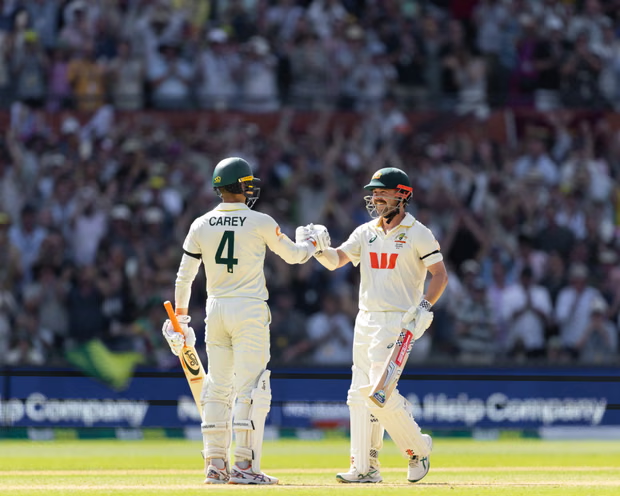
If England’s hyper-aggressive creed runs on belief, then it truly flatlined in Perth. That was where confidence drained away, where bodies and minds short-circuited under relentless pressure. Any flicker of revival in Brisbane was brief and illusory. By the time Travis Head, Usman Khawaja and Alex Carey settled in on the third afternoon in Adelaide, Bazball wasn’t being killed — it was being prepared for burial.
Australia’s dominance unfolded in a distinctly Adelaide way: unhurried, sun-soaked, and utterly suffocating. There was a neat irony in the tempo. Head, the same man whose 69-ball hundred tore England apart in Perth, saw no need for such violence this time. Instead, he dismantled England with calm, orthodox Test batting — a strike rate hovering comfortably in the 60s, brisk by any traditional standard, but never reckless.
There were moments of flair, of course. The familiar skip down the track, a lifted shot against spin, a crisp carve through the off side. But these were accents, not a philosophy. One daring six over long leg came and went, after which discipline returned. Singles were milked into the open spaces when Ben Stokes stacked the leg side. A chance on 99 went down at gully, and soon after Head raised his hundred from 146 balls. No fireworks were required.
Then came another layer of irony. Head was joined by Khawaja — perhaps the purest counterpoint to Bazball in modern Test cricket. From the moment England embraced chaos in 2023, Khawaja’s method felt like a quiet rebuttal. His Edgbaston hundred, compiled over eight hours, had arrived almost as a philosophical response to Joe Root’s whirlwind ton. As England leaned harder into speed, Khawaja simply slowed the game further, absorbing pressure with serene stubbornness.
Their 86-run stand in Adelaide carried yet another twist. While they calmly tightened Australia’s grip on the match, they were also, inadvertently, edging Khawaja closer to the end of his opening role. If that position was ever up for debate, Head’s unbeaten 142 likely settled it. Steve Smith will return to No. 4 in Melbourne, and Khawaja’s future may now hinge on whether selectors view him as a safer option at No. 5 than Josh Inglis lower down.
Should that happen, it would neatly complete a circle — back to the SCG, in the same middle-order role where Khawaja’s late-career renaissance began in 2022. Yet sentiment only stretches so far. With Australia not playing another Test until August, and a demanding future calendar looming, every selection now weighs present security against long-term planning.
For Head, those considerations may soon be viewed from the very top. His fourth century in Adelaide Tests further cements his authority, and alongside Carey he created a moment of local history — the first Adelaide-born pair to score hundreds in the same match. They didn’t share the first innings, but more than compensated in the second, pushing their stand beyond a hundred as the crowd revelled in a rare, homegrown takeover.
For a state long sensitive about its representation, this felt like a celebration overdue. No imports, no borrowed heroes — just two locals owning the biggest stage during the most convivial session of the match.
They will resume with Australia 356 ahead and ample time left. England’s bowlers look spent. Jofra Archer has emptied the tank across three days with bat and ball, shoulders sagging after seeing Head dropped off his final big effort. The rest offered little resistance, field settings grew tentative, and it is hard to imagine England’s batting mustering anything transformative when its turn arrives again.
Even the faint hope of late rain seems unlikely to interfere. The structure is already in place. The pyre is stacked. All that remains is for Australia’s bowlers to decide who strikes the match.
