
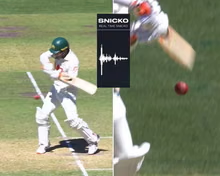
England formally raised their concerns with match referee Jeff Crowe after a Snicko malfunction denied them the wicket of Alex Carey, a moment that proved pivotal on the opening day of the third Ashes Test.
Brendon McCullum lodged the complaint overnight following the controversial Decision Review System call that allowed Carey to survive on 72 and go on to score a century. Carey’s 106 helped Australia reach 326 for eight at stumps, but England were left frustrated by what they believe was a clear edge that technology failed to capture correctly.
The incident came when Josh Tongue induced a nick behind, only for the on-field umpire to give Carey not out. England immediately reviewed the decision. Although a spike appeared on Snicko, third umpire Chris Gaffaney ruled that there was insufficient evidence to overturn the original call because the noise registered before the ball appeared to pass the bat. Under current protocols, spikes occurring after apparent contact are more readily accepted as confirmation.
Carey later admitted he thought he had made contact, saying he would have reviewed “in hope” had the decision gone against him. The controversy deepened when BBG Sports, the company that operates the Real-Time Snickometer, acknowledged an error during audio processing. The mistake occurred with Australia on 245 for six.
In a statement to BBC Sport, BBG accepted responsibility. “The only conclusion that can be drawn from this is that the Snicko operator at the time must have selected the incorrect stump mic for audio processing,” the company said. “In light of this, BBG Sports takes full responsibility for the error.” It is believed that audio from the non-striker’s end stump microphone was mistakenly used.
Following discussions between McCullum, team manager Wayne Bentley and Crowe after play, one of England’s lost reviews was reinstated. The ICC is also set to conduct a further investigation into the incident.
England’s bowling consultant David Saker did not hide his frustration. “The boys were pretty confident he hit it,” he said. “I think the calibration of the Snicko has been out quite a bit and that’s probably been the case for the series. There are things that don’t really measure up.
“At that stage it was a really important decision. Those things hurt, but you move on. In this day and age you’d think the technology is good enough to pick that up. We shouldn’t be talking about this after a day’s play.”
While DRS is compulsory in all World Test Championship matches, the Real-Time Snicko system used by host broadcaster Fox Sports in Australia is widely regarded as less advanced than the Ultra-Edge technology used by Sky Sports in England.
Carey himself acknowledged the oddity of the replay. “I thought there was a bit of a feather or some sort of noise as it passed the bat,” he said. “It looked a bit funny on the replay, with the noise coming early. If I was given out, I probably would have reviewed it, though not confidently.
“Snicko obviously didn’t line up, did it? That’s just how cricket goes sometimes. You get a bit of luck, and maybe it went my way today.”
For England, it was more than just bad luck — it was a costly technological failure that may yet shape the course of the Test.
