
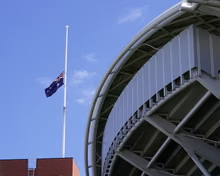
The third Ashes Test in Adelaide will not be the first played in the long shadow of modern terror. In 2005, England’s Ashes summer began just two weeks after the 7 July London bombings, with day one at Lord’s coinciding with a failed follow-up attack that misfired only through incompetence. Two decades on, Australian cricket finds itself confronting its own moment of national trauma.
The murders of at least 15 people at Bondi Beach on Sunday, during a Hanukkah celebration, represent the most heinous act of terror on Australian soil. In response, security for the Adelaide Test has been significantly heightened. Entry to the ground will be slower, armed members of South Australia Police’s new Security Response Section will patrol the Oval’s leafy surrounds, and the match is expected to begin with a moment of reflection led by the state’s premier, Peter Malinauskas.
Australia, in the days since Sunday, has felt like a country moving through shock in slow motion. News cycles have run constantly, replaying fragments of information, trying to make sense of something senseless. Early suggestions that the Test might be postponed or cancelled were quickly dismissed. As police commissioner Grant Stevens put it on the eve of the match, Sydney is being treated as a discrete event. “We don’t have any information whatsoever that indicates there’s a linkage between what happened in Bondi on the weekend and South Australia.”
No linkage in policing terms, perhaps. But emotionally and culturally, the threads are impossible to sever.
In Adelaide, public mourning has centred on the Adelaide Holocaust Museum and Andrew Steiner Education Centre, a mile from the Oval across the city grid. Malinauskas laid flowers there on Monday, followed by opposition leader Ashton Hurn, before the premier pledged $500,000 in funding. Yet by Tuesday morning, the centre had slipped back into quiet anonymity, save for a small cluster of flowers by the door on Wakefield Street, shaded by rows of jacaranda trees.
Next door, mass at the modern-gothic Catholic cathedral focused on the commercialisation of Christmas. Only the scrubbed and scoured stones of its outer wall hinted at deeper tensions — scars left by repeated antisemitic defacings in the years since the Hamas attacks of October 7, 2023, and Israel’s military response. CCTV footage not long ago captured local neo-Nazi groups giving fascist salutes outside the building.
Against that backdrop, assurances that Bondi is an isolated incident land heavily. Adelaide’s Jewish community is small — roughly a thousand people — yet incidents of antisemitism are frequent. Synagogues employ security guards on service days. Graffiti attacks are routine. Adelaide University has wrestled publicly with balancing free political expression against reports of hostility towards Jewish students.
This uneasily coexists with Australia’s self-image as a tolerant, immigrant-built society. The reality is more complicated. Racism has long been embedded in Australian life, and antisemitism in particular has surged. According to the Executive Council of Australian Jewry, incidents have tripled in the past two years. The chronology is chilling: an arson attack on a kosher catering business in Bondi in November 2024; the burning of Melbourne’s Adass Israel Synagogue in December; cars torched and daubed with antisemitic slogans in Sydney this January.
From afar, Australia has become a vivid case study in how violence in Israel and Gaza reverberates globally. Its Jewish population has the highest proportion of Holocaust survivors outside Israel — a fact Michael Visontay of The Jewish Independent describes as “central to its identity”. As he told The New Yorker, sensitivity to antisemitism and existential threat is “much more pronounced here than virtually anywhere else”.
At the same time, Australia is home to a large and youthful Muslim population, many of whom have voiced anguish and anger over Israel’s actions in Gaza. The collision of these realities — layered grief, rage, fear and identity — found its most grotesque expression in the violence at Bondi.
And Bondi of all places. As Rabbi Yossi Engel of Adelaide’s Chabad synagogue observed, Bondi Beach is “a symbol of open Australia… as plain good old Aussie as it gets”.
So, too, is the cricket. Australia’s summer ritual now proceeds against that same sense of rupture. Even the announcement of the home XI this week triggered a wave of online abuse directed at Usman Khawaja, tied to his previous expressions of concern for Palestinian civilians — a reminder that the fissures exposed by Sunday’s atrocity run deep and wide.
Sport moves on, as it always does, carrying its own theatre and rivalries into a changed world. The Ashes will unfold under broadcast lights and global scrutiny, becoming, inevitably, a window beyond the boundary rope — to grief, to unease, to a nation trying to locate itself after horror. What happens at Adelaide Oval will be recorded forever alongside the images and echoes of this tour, part of an Australian summer that will never quite feel the same again.
