
Cricket is miserable when you’re bad at it. And everyone, at some point, is bad at cricket. Even Ben Stokes. The first time someone hurled a ball at him, it didn’t disappear into the stands. He was useless, like everyone else at the beginning. The difference is that he got better quickly enough to stay. Because stay rubbish for too long and the thought creeps in: this is pointless, let’s get out of here.
That simple truth sits at the heart of Square One, a bold experiment that believes cricket doesn’t need saving so much as restarting — stripping the game back, removing its barriers, and rebuilding it for people who’ve never been invited in.
Everyone claims to want cricket to be more inclusive: less elitist, less opaque, less of a private garden party for those who already know the rules. The ECB has published report after report acknowledging the game’s problems — racism, sexism, class barriers — usually with a faint air of surprise, as if these issues belong to someone else. The harder question has always been: what do you actually do about it?
“My view is we’ve created the most inclusive cricket centre in the world,” says Rob Ferley, former Kent and Nottinghamshire spinner, coach, provocateur, and one of the sharpest free thinkers in the game. He’s also the man who bluntly sums up cricket’s biggest flaw: if you’re rubbish at it for too long, you leave.
“You’ve got to break the bloody wheel,” Ferley says. “Cricket has barriers everywhere — language, culture, who gets access. Coach education is still crap. State schools are still underserved. We keep sending the same people back with the same programmes and expecting different results. That’s insanity.”
Across the table sits Dr James Wallis, a sports science lecturer at Brighton University whose career has been built on understanding how people learn sport — not just how they perform it. Next to him is Rod Aldridge, entrepreneur, philanthropist and the driving force behind Square One’s existence.
Together, they’ve turned an old tennis hangar beside the A27 in Falmer into something remarkable.
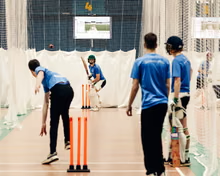
Three weeks old at the time of writing, Square One Falmer is now the second-largest indoor cricket facility in the world. Only Melbourne has a bigger one. It’s pristine, cavernous, bright, and — crucially — unintimidating. No grey nets. No peeling paint. No sense that you’ve wandered into a place where everyone already knows more than you.
It sits right next door to Brighton Aldridge Community Academy, a co-ed state school run by Aldridge’s trust. The school already had a solid cricket programme. The facility was there. So Aldridge did something quietly radical.
“We took the gate down,” he says.
Not built a fence. Took one away.
On a wet Thursday lunchtime, BACA students stream across the grass into the hall, carrying kit, laughing, warming up. Cricket isn’t something separate from school life here. It’s part of it.
The founding idea is simple but powerful: make cricket welcoming, whether you’re touching a bat for the first time or chasing elite performance. Everything about the space reflects that.
The nets are colour-coded, with rainbow-style markings on the pitch that visually show length — removing the foggy jargon of “good length” or “a bit short.” There are coloured zones to aim at with the bat. It’s coaching without language, or at least without inherited language.
“It’s a common code,” Wallis explains. “Non-verbal. You don’t need to already understand cricket to understand what’s happening.”
Then there’s the technology. Balls are microchipped. Every delivery records speed and trajectory. Batters see virtual fields and shot maps. Runs appear on screens. It’s gamified, immersive, addictive — and physical. Lancashire are already using the tech. What’s new is that here, kids in PE lessons and members of the public get access to the same tools.
This is cricket reimagined not as tradition, but as experience.
The ambition stretches far beyond Falmer. Ferley wants 150 Square One centres across the country — in schools, beside schools, in repurposed spaces, anywhere cricket doesn’t currently exist.
“Why should geography decide opportunity?” he asks. “If you’re born in Northumberland, or Wales, why should you have less chance of becoming a cricketer than someone in Surrey?”
It’s a challenge to the pyramid itself. County pathways begin narrowing at 14, Wallis points out, creating self-fulfilling prophecies. Invest in a few early, and they thrive. Miss out early, and you’re gone — talent undiscovered, passion extinguished.
Square One offers an alternative: a place to keep going, to be measured, seen, and challenged later. If a 22-year-old is bowling 85mph in Swansea or Staffordshire, the data doesn’t lie. Talent becomes harder to ignore.
It also questions cricket’s sacred cows. Ferley is particularly scathing about hard-ball cricket for young children.
“We throw something really hard at kids who don’t yet have the skills to protect themselves,” he says. “They get hit, it hurts, and we call it character-building. Why? If you started from scratch, would you really design it this way?”
The thinking here is broad — cognitive, emotional, social. Cricket as a vehicle, not just an end. A place where people grow, not just players.
Which makes Ferley’s views on England’s current Bazball era all the more interesting. He admires it — especially the autonomy Stokes and Brendon McCullum give their players. England, he says, is probably the best place it’s ever been to be an international cricketer.
But he also sees limits.
“Bazball empowers players, and that’s great. But empowerment without challenge has a ceiling. Everyone wants to be the best in the world — not just England.”
That tension — between freedom and structure, between tradition and reinvention — is exactly what Square One is trying to resolve.
“Bazball is seen as revolutionary,” Ferley says. “But why should it be? Why is it radical in cricket to try something different?”
Standing inside this vast, light-filled barn in Falmer, watching kids run drills without fear or confusion, the question feels less rhetorical than urgent. Maybe cricket doesn’t need tweaking at the edges. Maybe it needs to go back to square one — and build forward, properly, for the first time.
